
Buying Property in Dubai | Singapore Investor Guide
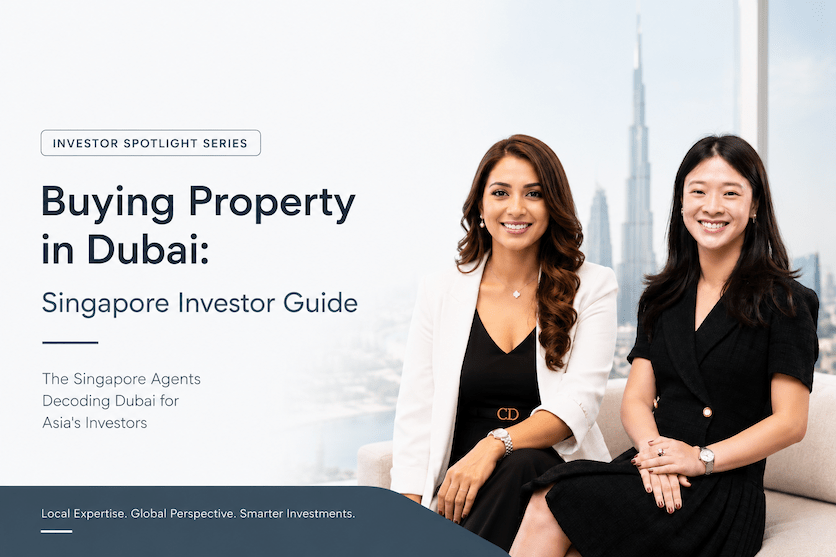
The Singapore Agents Decoding Dubai for Asia’s Investors
Dubai keeps coming up. In group chats, at dinner, in the comments of every property post shared around. Singapore investors are paying attention, and the questions have gotten more specific. Not “should I look at buying property in Dubai” but “how does it actually work, what does it really cost, and is the opportunity as real as people are saying?”
We spoke with 2 agents who work specifically with Singapore and Asian buyers. One specialises in townhouses and villas, the side of the Dubai property market that surprises most Asian investors. The other comes from a luxury property background in Singapore and now advises HNW buyers on buying property in Dubai. Between them, they cover a lot of ground.
Libby Barber
Specialisation: Villa & Townhouses | Communities: The Greens & Views, Emirates Living
Linda’s Real Estate | RERA No. 90331
Libby works primarily with Singapore and Asian buyers looking at townhouses and villa communities. She’s had the same conversation hundreds of times. A buyer calls expecting to talk about apartments. They leave thinking about something they never considered, at a price point they didn’t expect.
1. What’s the one thing Singapore investors always ask you first?
Whether Dubai has something like ABSD or annual property taxes.
The answer genuinely surprises people.
There’s no annual property tax in Dubai. You pay a one-time 4% Dubai Land Department fee and around 2% in agency fees at purchase. After that, nothing recurring. For Singapore investors used to watching stamp duty eat into returns before they’ve even started, that changes the entire calculation.
2. Which communities are most popular with your Singapore and Asian clients?
Townhouses and villa communities.
The price of a townhouse in Dubai is often comparable to a 2-bedroom condo in Singapore, but you’re getting a completely different lifestyle. More space, a garden, family-friendly amenities, actual greenery and walkability. A lot more space and considerably less price pressure.
3. What do Singapore investors get wrong about Dubai before they speak to you?
Many assume it’s either backwards or purely flashy. Once they visit, they find it’s modern, highly international, and in many ways similar to Singapore, just located in the middle of the desert.
It’s a global hub with strong infrastructure, safety, and efficiency. That makes the transition surprisingly comfortable for Singapore investors looking at property investing here for the first time.
4. What do people ask about off-plan property most often?
Whether off plan property is actually worth it compared to buying something that already exists and generates income immediately.
Ready properties give you rental income from day one. Off-plan is a different kind of bet. You’re buying into where an area is going before prices catch up. You can often gauge long-term potential by looking at a developer’s track record and the infrastructure being built around it.
5. Which communities do you recommend for yield versus lifestyle, and are they different?
For rental yield, JVC, Arjan, Town Square, and parts of Dubailand. Strong rental demand, good entry prices…
For lifestyle, Singapore investors are usually drawn to Dubai Hills Estate, The Greens, Dubai Creek Harbour, and Dubai Marina. Green, walkable, near water.
Worth noting: Lifestyle-driven communities often make strong long-term investments too. Areas with end-user demand, good infrastructure, and waterfront elements tend to hold their value well through market cycles.
6. What’s the biggest mistake you’ve seen investors make on their first Dubai purchase?
Investing in property in Dubai without understanding the fundamentals. Investors chase whatever project is trending online without looking at the developer’s reputation, supply in the area, service charges, future competition, or actual end-user demand.
7. What’s the yield killer nobody warns investors about?
Service charges.
Investors fixate on the gross rental yield and forget that service charges come off the top every year. In some premium developments, those fees can be high enough to turn an attractive headline yield into a much less exciting net return. It’s the first thing I go through with any client before we look at anything else.
Related: More on Service Charges and Extra Fees
8. What do you not recommend when it comes to investing in Dubai real estate?
Don’t go straight to a developer. Many buyers find it useful to speak with independent agents who can compare multiple developers and communities across the market. An agent isn’t limited to one developer, which means you have broader options.
Sunita Gill
Specialisation: Luxury Properties & HNW Clients | Covers: Singapore & Dubai
Singapore Luxury Homes (Singapore) | Asp1re Real Estate LLC (Dubai) | RERA No. 96629
Su spent years working with Singapore’s most discerning property buyers. Now she brings that same lens to investing in Dubai real estate. Her clients are not looking to be sold on Dubai. They want someone who will tell them the truth about it.
1. What’s the first thing Singapore investors ask you when they’re considering Dubai?
“Is this real, and is it sustainable.” Almost every time.
Singapore investors come from one of the most regulated and stable property markets in the world, so the first instinct is to look for the catch.
What they find when they study the numbers… the population growth, the government’s long-term vision, the infrastructure investment, the global wealth migration, the tax environment, the rental yields… is that the Dubai property market today is different from the one people were cautious about 15 years ago.
That conversation shifts quickly once the data is on the table.
2. What mistakes do Singapore investors make when they first look at this market?
Comparing Dubai to Singapore one-for-one.
Singapore and Dubai operate differently as property markets, with different investor profiles, pricing dynamics, and growth characteristics.
In Singapore, investors are used to low yields, high entry prices, and heavy cooling measures. Dubai moves differently. Another mistake is only looking only at price per square foot instead of lifestyle demand, rental demand, and future infrastructure around a project.
3. What does a Singapore investor worry about most when buying somewhere they don’t know physically?
Control.
Singapore investors want clarity, structure, and transparency. They worry about whether they can trust the developer, whether the property will perform, and who manages everything after purchase.
That’s a valid concern. It’s also exactly why having the right team on the ground matters. You need people who understand both the Singapore mindset and the Dubai ecosystem, legally, financially, and operationally.
4. Can a Singapore buyer realistically buy and manage a Dubai property without ever being here?
Yes, and that’s how many clients do it today.
Viewings, legal documentation, payment tracking, tenant management, furnishing, and resale can all be handled remotely when the right systems are in place. Buying property in Dubai from abroad is genuinely possible.
5. Is the Golden Visa a real motivator for Singapore buyers or more of a nice-to-have?
It starts as a bonus and becomes strategically important. Most Singapore buyers aren’t looking to leave Singapore. But they are thinking more globally about business, education, tax planning, and lifestyle flexibility.
The Golden Visa stops being about migration and starts being about optionality. Future-proofing your family’s choices without disrupting what you’ve already built. That framing lands very differently from the word “visa.”
Related: Complete UAE Golden Visa Guide for 2026
6. For someone sitting on the fence in Singapore right now, what do you tell them?
Don’t rush blindly, but don’t ignore what’s happening either.
Wealth is becoming more mobile. Businesses are becoming more global. Families want options. The investors who tend to do best are the ones who enter a market before everyone feels comfortable with it, not after the opportunity becomes obvious to the world.
7. What did you believe about Dubai before you moved here that turned out to be wrong once you were on the ground?
That understanding Dubai was enough. It isn’t.
When you’re advising someone on investing in property in Dubai, it matters more that you understand where they’re coming from than that you simply know the market.
The nuances of how a Singapore investor thinks, what they’ve been conditioned to expect, that context shapes everything.
Thinking about buying property in Dubai from Singapore? Both agents are available for a direct conversation if you have questions or want a clearer understanding of the process.
FAQ: Buying Property in Dubai as a Singapore Investor
Q. Can foreigners legally buy property in Dubai?
Yes. Overseas investors can buy freehold property in designated areas in Dubai without needing UAE citizenship or residency.
Q. What taxes do Singapore investors pay when buying Dubai property?
Currently, Dubai does not impose an annual property tax or capital gains tax on residential property in the way many global cities do. But, buyers still pay upfront transaction costs such as Dubai Land Department (DLD) fees, agency commissions, mortgage fees (if applicable), and ongoing service charges.
Q: Is there stamp duty in Dubai like Singapore’s ABSD?
No. You pay a one-time 4% Dubai Land Department fee and around 2% agency fee at purchase. No annual property tax, no ABSD equivalent.
Q. Can I get a UAE residency visa by buying property in Dubai?
Yes. A long-term UAE Golden visa (10 Year) is available to property buyers investing AED 2 million or above. Renewable, includes family members, no minimum stay required.
More in details: Type Of Dubai Property Visa
Q: What rental yield can I realistically expect?
Gross yields in the Dubai property market typically range between 6% and 9%, although actual returns vary depending on property type, vacancy, service charges, and market conditions.
Q: Which communities are most popular with Singapore buyers?
For lifestyle: Dubai Hills Estate, The Greens, Dubai Creek Harbour and Dubai Marina.
For yield: JVC, Arjan and Town Square.
Q. Is it better for Singapore investors to buy off-plan or ready property in Dubai?
Off-plan property may offer lower entry prices and flexible payment plans, while ready property can provide immediate rental income and lower construction risk. Singapore investors often choose based on whether they prioritize cash flow, capital appreciation, or shorter investment timelines.
Related: Off-plan or Ready property in Dubai (Quick Comparison)
Q. What are the biggest risks Singapore investors should understand before buying Dubai property?
Common concerns include project delays for off-plan property, service charges, oversupply in certain areas, currency exchange risk between SGD and AED/USD-pegged pricing, and choosing inexperienced developers. Investors should also compare realistic rental yields versus marketing claims.
